Mixkit is a free sound effects website where we downloaded a door-slam WAV without an account. Its license permits commercial use without mandatory credit.
A door slam can sell a visual cut, while room tone can hide an edit in dialogue. The right recording also needs permission for the way you plan to publish. For a music bed, see our guide to free music for videos.
On October 28, 2026, we downloaded one original file each from Mixkit, BBC and Orange without signing in, then checked metadata and permissions. We opened the BBC download notice and license in a browser. For the other eight sources, we checked licenses or workflows without downloading originals. We measured Freesound’s public low-quality preview separately. The Google account workflow was not tested; no listening test or catalog-quality ranking was performed.
📋 TL;DR • Three original downloads: Mixkit and BBC delivered WAV files; Orange delivered an MP3. • YouTube Audio Library: Google documents a Studio sign-in workflow and monetization for YouTube Partner Program members. • BBC social uploads: The archive’s FAQ and license give conflicting guidance.
How do eleven free sound effects sources compare?
The table summarizes documented permissions and conditions; the three measured downloads appear separately below.
| Source | Documented permissions | Important condition |
|---|---|---|
| Mixkit | Commercial use permitted; credit optional | Standalone redistribution, including as stock, in templates or with source files, prohibited |
| YouTube Audio Library | YouTube Partner Program members can monetize videos with Audio Library sound effects | Access is through YouTube Studio sign-in |
| BBC Sound Effects | Specified personal, research or formal educational uses; credit required | FAQ and license conflict on social uploads |
| Orange Free Sounds | Tested recording is CC BY-NC 4.0: non-commercial use with attribution | Link to the license and indicate changes |
| Freesound | CC0 and CC BY permit commercial use; CC BY-NC is non-commercial | Credit and license versions depend on the recording |
| Pixabay | Commercial and non-commercial use permitted; credit optional | Standalone redistribution prohibited; other rights may apply |
| ZapSplat | Basic license permits commercial use with credit wherever reasonably possible | Basic downloads are MP3 and subject to download limits |
| Sonniss | Archive sounds are commercially usable for media production without attribution | AI and machine-learning training prohibited |
| Adobe Express | Asset-dependent standard or Limited License – Adobe Express | Editor workflow; Limited License does not permit standalone asset export |
| 99Sounds | Commercial use permitted; credit optional | Use in noise, white-noise and sleep-sound apps prohibited |
| FreeSoundEffects.com | Free category is for personal, non-commercial projects | Full license wording is under review |
What did we find in the three original downloads?
The three files differ in format and permissions. Mixkit’s sample permits commercial use without credit; the following cases explain the BBC and Orange restrictions.
| Source and recording | Downloaded format | Rights for this recording |
|---|---|---|
| Mixkit, “Slamming a door” | Stereo WAV, 44.1 kHz, 24-bit; about 1.7 seconds | Commercial use permitted; credit not required; no redistribution as stock sound effects |
| BBC, “Nestling bill-snapping” | Stereo WAV in a ZIP, 44.1 kHz, 16-bit; about 19.8 seconds | Conditional personal, research or formal educational use; credit required; social-upload guidance conflicts |
| Orange Free Sounds, “Door Slam With Creak Sound Effect” | Stereo MP3, 44.1 kHz, 192 kb/s; about 2.0 seconds | CC BY-NC 4.0: attribution required, commercial use excluded |
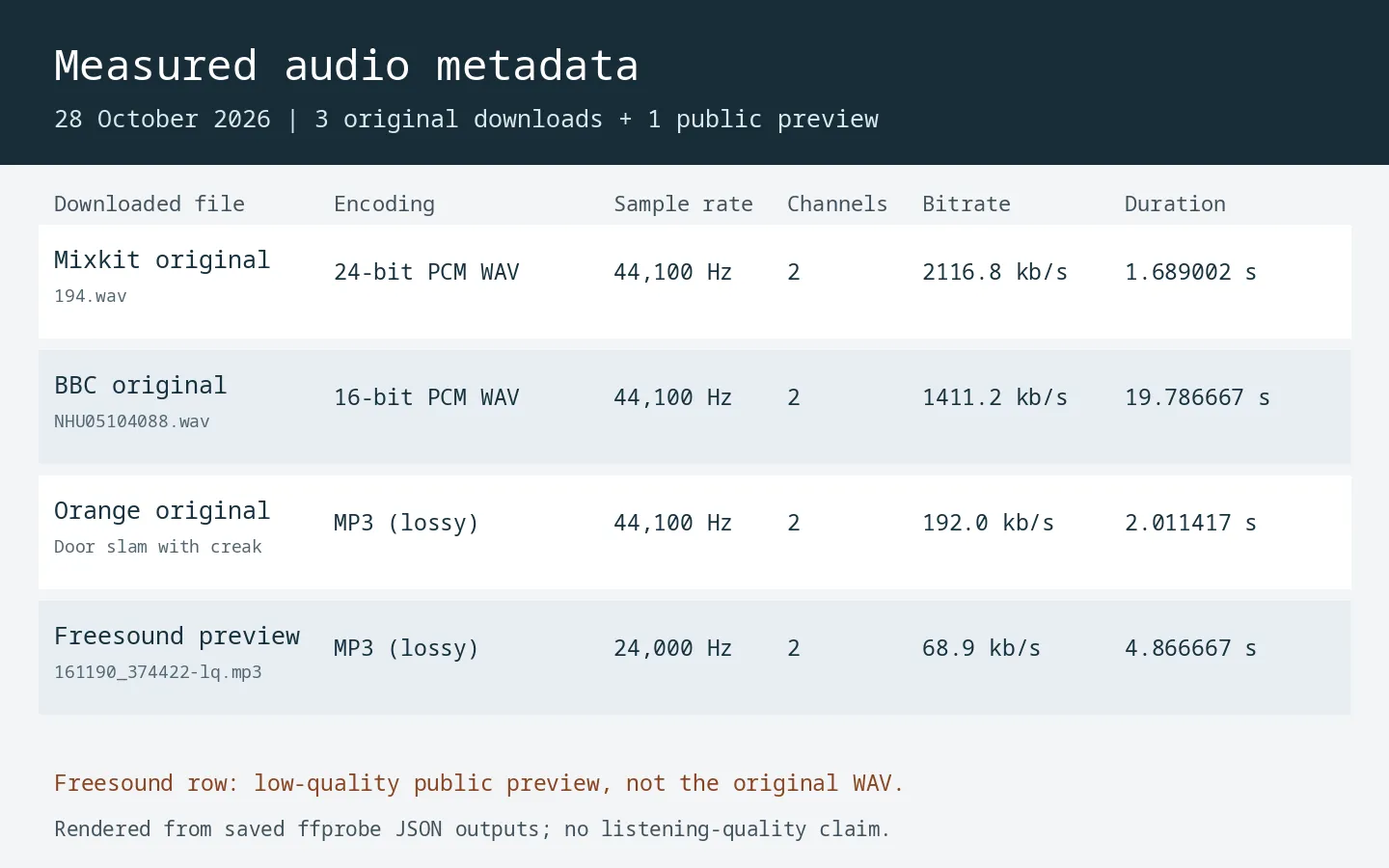 Metadata from three original downloads and a separate Freesound low-quality preview, checked October 28, 2026.
Mixkit: a door slam for commercial projects
In our tests, Mixkit’s “Slamming a door” arrived as an original WAV without an account. The file is stereo, 44.1 kHz and 24-bit PCM, with a duration of about 1.7 seconds (Mixkit, 2026). A short, uncompressed door effect gives an editor a source to trim and place against a visual action without first converting a lossy MP3.
The Mixkit sound effects license permits commercial and non-commercial projects. Its sound-effects FAQ says attribution is appreciated but not required. The license prohibits redistribution of the sound on its own, including as stock, in templates, or with source files. The catalog lists Whoosh, Transition and Interface categories for those searches.
BBC Sound Effects: an owl recording under RemArc
The BBC’s “Nestling bill-snapping,” recording NHU05104088, is identified as a tawny owl recording under Nature and Woodlands. The original arrived without an account in a ZIP containing a stereo WAV: 44.1 kHz, 16-bit PCM and about 19.8 seconds (BBC recording, 2026). That longer file lets you select a passage for a permitted research or educational project instead of treating the whole recording as a short effect.
The archive’s RemArc terms permit specified personal, research and formal educational uses, not blanket non-commercial publication. Its download notice excludes commercial use and directs buyers to Pro Sound Effects through each recording’s “Show details” panel. There is also a conflict worth noticing: the BBC FAQ describes non-commercial YouTube use, but the license says “no uploading to social media sites.” We would not treat this free download check alone as clearance for a public social video; confirm permission for that use.
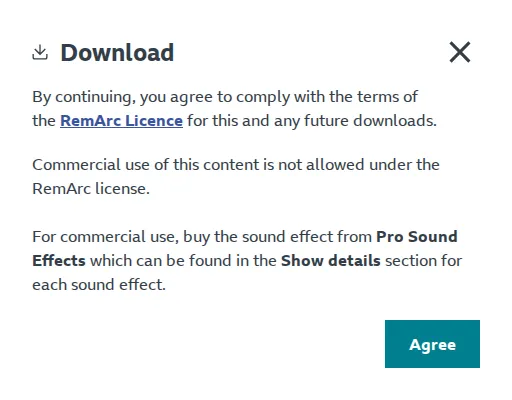 BBC WAV download notice captured October 28, 2026.
Where credit is not already supplied, the BBC asks for a prominent credit using “bbc.co.uk – © copyright [the year goes here] BBC” and, if possible, a link to the original content. Its rendered terms leave the year as a placeholder without explaining which year to insert; do not infer a year from the recording’s metadata. Keep the asset identifier and confirm the appropriate credit if that date is unclear.
Orange Free Sounds: a door effect with attribution
We measured Alexander’s “Door Slam With Creak Sound Effect” after downloading it without an account: stereo MP3, 44.1 kHz, 192 kb/s and about 2.0 seconds (Orange Free Sounds, 2026). The page also advertises 16-bit audio, but that source bit depth cannot be established from the downloaded lossy MP3. Its download button supplies a ZIP containing the same MP3 and a license note.
The recording’s page identifies it as CC BY-NC 4.0: it requires attribution and excludes commercial use. Credit Alexander, identify the recording, link to its source and license, and indicate if you changed it.
What about other free sound effects websites?
These eight documented options offer different licenses and workflows.
YouTube Audio Library
Google’s Audio Library help directs creators to sign in to YouTube Studio, open Audio Library and select the Sound effects tab. Search by keyword or filter by category and duration. Google says YouTube Partner Program members can monetize videos using Audio Library music and sound effects. Its attribution examples concern music: Creative Commons tracks require artist credit, while standard-license music does not. Those examples do not establish a credit rule for every sound effect.
Freesound
Freesound licenses vary by recording. “storm door slam 01.wav” by volivieri currently shows Attribution 4.0, linked to CC BY 4.0. Its original download requires login; the public low-quality preview is a stereo MP3 measuring 24 kHz and about 4.9 seconds. This is not the HQ preview or original. The page lists the original as a 96 kHz, 24-bit stereo WAV; those are page specifications, not measurements (Freesound recording, 2026).
Pixabay
Pixabay’s license summary says its content is free to use, attribution is not required, and users may adapt it. Its full terms permit commercial and non-commercial use, prohibit standalone redistribution and warn that other rights, including rights in recognizable brands or people, may need attention.
ZapSplat
ZapSplat’s Standard License permits commercial projects, but Basic users must credit ZapSplat wherever reasonably possible. Basic downloads are MP3 and require an account, with limits; the site also describes paid benefits.
Sonniss
Sonniss offers GameAudioGDC bundles for building a sound library. Its archive listing says the sounds are commercially usable for media production without attribution, and prohibits AI and machine-learning training.
Adobe Express
Adobe Express is an editor workflow, not a standalone sound effects library. Adobe’s Express contributor FAQ says Free collection content uses a standard license, while content outside that collection uses the Limited License – Adobe Express. The latter permits publishing or downloading a finished Express project but not exporting the asset as a standalone file.
99Sounds
The Rain And Thunder pack page lists rain and distant thunder recordings and advertises 24-bit, 44.1 kHz stereo WAVs; these are published specifications, not measurements of a file we obtained. The free-price checkout was not completed. The 99Sounds license permits commercial projects without attribution but restricts standalone redistribution and use in noise or sleep-sound apps.
FreeSoundEffects.com
The site’s Usage Information limits the free category to personal, non-commercial projects; paid purchases are separate. The vendor says its full license wording is under review.
🚀 Your sound design is part of the finished video Once the edit is ready, the player and hosting experience still shape how viewers receive it. A branded, ad-free player keeps a polished video from handing attention to unrelated recommendations. See how SmartVideo supports videos on your own site →
How should you choose and use a free sound effect?
Choose a free sound effect for its permitted use, not just its download button.
A file for a personal class project may have different permissions from a file in an agency’s paid advertisement. Before adding any recording to the timeline, check these five details:
- Commercial use: Does the license cover the actual project and distribution, including client work, monetization or paid advertising where relevant?
- Attribution: Is credit required, who must be named, and where does the license say to put it? Save the exact wording and source link.
- Format: An uncompressed WAV is useful for substantial editing; MP3 is smaller but lossy. Converting an MP3 to WAV does not recover the information lost to compression.
- Redistribution: Permission to use a sound in a finished video is not necessarily permission to share the raw recording. Check before sending source assets to a client or uploading them to a shared library.
- Access and limits: An account, a download cap, checkout or a paid tier for a particular format can change the workflow. Confirm those details for the file you intend to use.
“Royalty-free” describes a licensing arrangement, not a guarantee that a recording is copyright-free, attribution-free or suitable for every use. Read the actual terms and consider other rights that may apply, such as an identifiable person’s privacy or a trademark in the surrounding material.
Mark title entrances, cuts, movements, product interactions and location changes before searching. Start with the visual action: “door close,” “paper fold” or “camera move” is more useful than “cool sound.” Add a material or setting when needed, such as “rubber sole footsteps hallway.”
- Foley: footsteps, cloth movement, keys, paper, doors, switches, dishes, zippers and typing.
- Whooshes and transitions: whoosh, swoosh, sweep, pass-by, riser, reverse, impact, stinger and logo reveal.
- Ambience: room tone, office, city, traffic, rain, wind, forest, ocean, crowd and machinery.
- Interface and product cues: click, tap, toggle, pop, notification, success, error and confirmation.
Place each sound against the visual beat and trim its beginning and end. A whoosh slightly ahead of a graphic’s movement can emphasize the action, while a quiet ambience bed can join shots that otherwise feel disconnected. Layer with restraint: a soft impact may reinforce a transition, but several competing effects can obscure it.
Keep dialogue intelligible by lowering effects during speech and raising them in the gaps where appropriate. Check the resulting mix on headphones and small speakers, not just in isolation. For related steps, see our guides to voiceover recording and cleanup and editing a video.
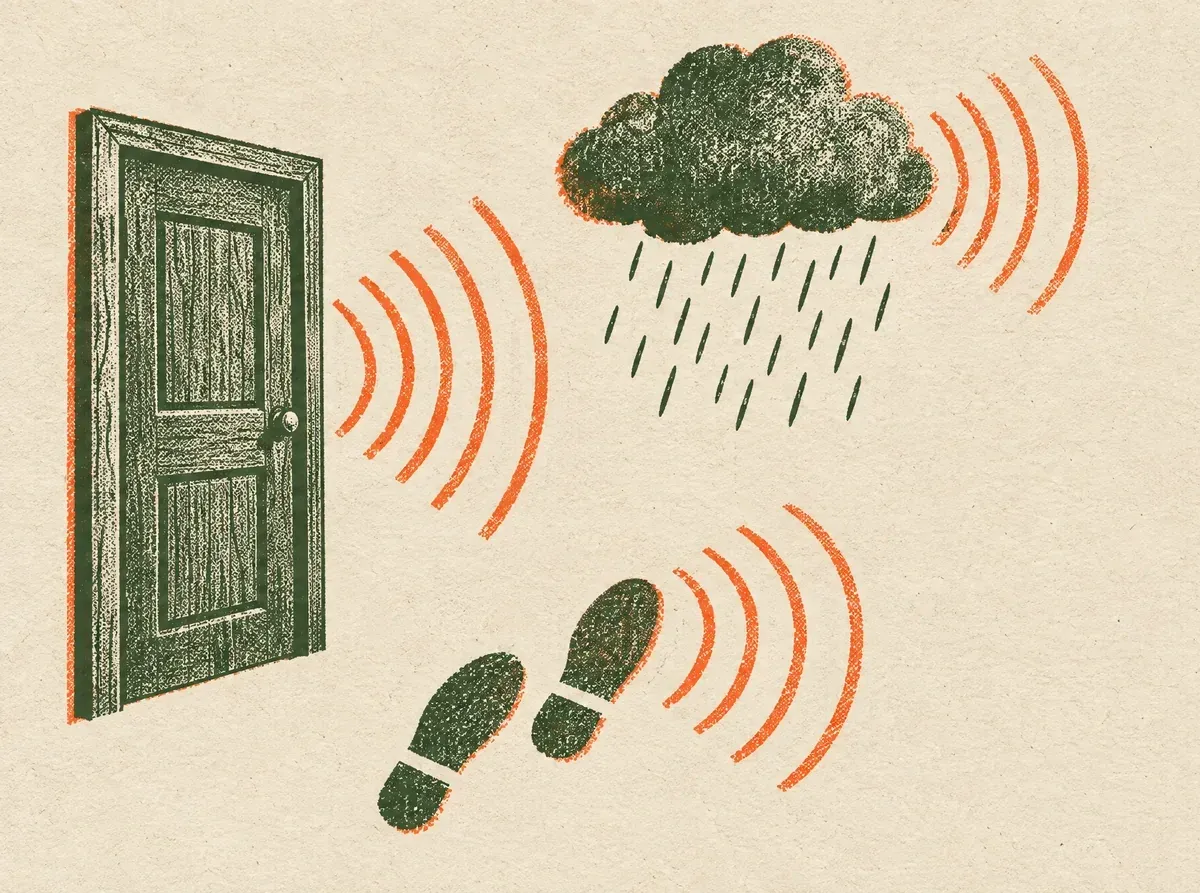 Use “door close” and “footsteps” for Foley searches; use “rain” for ambience.
Frequently asked questions
Free sound effects still have recording-specific permissions. These answers cover commercial use, required credit, file formats and mixing decisions without treating “free” as a substitute for a license.
Can I use free sound effects in commercial videos?
Yes, if the recording’s license permits your particular commercial use. The Mixkit sample does; the BBC’s free archive terms and the tested Orange recording do not provide blanket commercial permission.
Do I have to credit free sound effects?
It depends on the license. Mixkit does not require credit for the tested effect, while the Orange sample requires attribution and the BBC supplies a copyright credit template.
Can I use Freesound recordings on YouTube?
Freesound’s license FAQ describes CC0 sounds as usable commercially without copyright credit, CC BY as allowing commercial use with credit, and CC BY-NC as requiring credit and excluding commercial use. Licenses and versions vary by recording, and older sounds may use the legacy Sampling+ license rather than one of those three. User-uploaded material can also raise other rights or mistaken-claim issues.
What is the difference between WAV and MP3 sound effects?
WAV files commonly contain uncompressed audio, while MP3 uses lossy compression to reduce file size. An uncompressed source is useful for heavy processing, but converting an existing MP3 to WAV cannot restore lost detail.
Can I use BBC sound effects in a monetized video?
No, not under the free RemArc terms. BBC directs commercial users to Pro Sound Effects through each recording’s Show details panel.
Can I use ZapSplat sounds without attribution?
Basic users must credit ZapSplat wherever reasonably possible under its Standard License. Premium terms offer attribution-free use.
Are free sound effects copyright-free?
Many free recordings remain copyrighted and are available under a license. CC0 is a public-domain dedication, but it does not itself clear other people’s privacy, publicity or trademark rights or guarantee that an uploader owns the recording.
How loud should sound effects be under dialogue?
Keep the words intelligible without requiring the viewer to strain or adjust the volume. Automate effects down during speech and listen on more than one playback device before delivery.
What should you save with your finished edit?
Save each sound effect’s URL, creator, license, attribution text and download date alongside the project. Keep separate records for any free B-roll footage too.
Review the mix and credits in the final export, then choose an appropriate video format and delivery method for the audience. Hosting is a separate decision from sound licensing; see why you might use a video host rather than upload directly to WordPress.