
The best YouTube alternatives in 2026 depend on your goal: creators looking for algorithmic reach should consider TikTok, Twitch, or Kick, while businesses need ad-free hosts like SmartVideo, Wistia, or Vimeo that load fast and keep visitors on-site. This guide covers both sides—but if you run a business website, pay close attention to the first seven platforms. A dedicated video host removes competitor ads, loads instantly, and keeps potential customers engaged on your own landing pages instead of sending them back to YouTube.
You’ve spent hours producing a high-quality product video. A prospect clicks through from your email campaign, lands on your site, and hits play. But instead of watching your carefully crafted pitch, they see a pre-roll ad, a buffer wheel, and a grid of related videos linking directly to your competitors. If you use the default YouTube player on your landing pages, this scenario is actively hurting your bottom line.
Social video distribution and on-site video hosting are fundamentally different. YouTube remains the dominant platform for top-of-funnel discovery—it now captures the largest share of U.S. TV screen viewing of any single media company, hitting 12.5% in January 2026 (Nielsen, 2026). But for business websites, embedding a native YouTube player damages your conversion rates and leaks your traffic.
The 10 alternatives below cover both sides — discovery and on-site hosting — with a focus on choosing the right platform to host videos without YouTube.
📋 TL;DR • The Split Strategy: Use YouTube for reach and discovery, but use an ad-free alternative for your website embeds. • Best for websites: SmartVideo offers ad-free, distraction-free playback with unlimited bandwidth for business sites. • Best for B2B marketing: Wistia provides deep analytics, though at a premium price. • Best for creators: TikTok and Twitch remain the top alternatives for building social audiences away from YouTube.
ℹ️ What is a business video alternative? While creators look for alternatives to replace YouTube’s algorithm and monetization (like Twitch or Kick), a business alternative focuses on professional video hosting. It provides clean, ad-free embeds with fast load times designed specifically to keep viewers on your website.
Top 10 YouTube Alternatives at a Glance
The best YouTube alternatives are SmartVideo, Vimeo, or Wistia for business websites, and TikTok, Twitch, or Kick for creators chasing reach — here is how all ten stack up.
| Platform | Best For | Ad-Free? | Starting Price | Bandwidth | WP Plugin | Analytics |
|---|---|---|---|---|---|---|
| SmartVideo | Business websites & WordPress | Yes | $19/mo | Unlimited | Native block | Engagement |
| Vimeo | Creative portfolios & general B2B | Yes | $12/mo (annual) | Capped (2 TB/mo) | Embed code | Advanced |
| Wistia | In-house marketing teams | Yes | $79/mo (Business) | Plan-based | Embed code | Heatmaps + CRM |
| Brightcove | Enterprise media & broadcasting | Yes | Custom | Custom | Embed code | Enterprise suite |
| SproutVideo | Internal comms & basic hosting | Yes | $15/mo ($12/mo annual) | 1,800 GB/yr pooled (annual billing) | No | Basic |
| Bunny Stream | Developers & custom apps | Yes | ~$1/mo (Pay-as-you-go) | Pay-per-GB | No | Basic |
| Presto Player | WordPress users with own hosting | Yes | $79/yr (Starter) | BYOH | Native block | Basic |
| Jetpack VideoPress | Basic WordPress hosting | Yes | $9.95/mo ($4.95/mo first year) | Included | Native (Jetpack) | Minimal |
| TikTok | Short-form viral discovery | No | Free | N/A | No | Creator dashboard |
| Twitch & Kick | Live community engagement | No | Free | N/A | No | Stream analytics |
Why Do You Need Two Platforms? The Split Strategy
You need two platforms because discovery and on-site hosting are different jobs: social platforms like YouTube and TikTok win attention, while a dedicated video host delivers clean, ad-free playback on your own website.
Many businesses make the mistake of looking for a single video platform to solve every marketing challenge. They want the massive audience of YouTube, but they also expect the clean, professional embeds of a premium host. The reality is that these two goals are fundamentally opposed.
YouTube is a social network designed to keep viewers on YouTube. Every feature of its embed player—from the related videos grid to the prominent logo linking back to YouTube.com—is engineered to pull your site visitor away from your landing page and into their ecosystem.
The solution is the Split Strategy:
- Top of Funnel (Discovery): Keep uploading your content to YouTube. Optimize for their algorithm, build your subscriber base, and use it as a massive search engine to capture new prospects.
- Bottom of Funnel (Conversion): Never embed YouTube on your own website. For landing pages, product pages, and blog posts, host the video on a professional, ad-free alternative.
🎬 Stop Leaking Website Traffic Using YouTube on your site sends potential customers straight to your competitors through related videos. Learn how the Split Strategy fixes this with SmartVideo.
What Are the Best YouTube Alternatives for Business Websites?
The best YouTube alternatives for business websites are dedicated ad-free video hosts: SmartVideo, Vimeo, Wistia, Brightcove, SproutVideo, Bunny Stream, Presto Player, and Jetpack VideoPress, compared in detail below.
Implementing the Split Strategy means replacing YouTube embeds on your own site. These are the top video hosting platforms for businesses to make that switch.
1. SmartVideo (Best for Business Websites)
SmartVideo by Swarmify is built for one thing: fast, high-quality playback on your own website without the bloated features or heavy price tags of enterprise platforms.
 SmartVideo’s WordPress settings allow for deep customization and schema markup.
While standard YouTube embeds load roughly 1.2MB of JavaScript, tracking scripts, and thumbnail assets—severely impacting your Core Web Vitals—SmartVideo uses an optimized, lazy-loaded player that adds just 15KB initially. It uses a global Content Delivery Network (CDN) for near-instant start times and minimal buffering, regardless of where your viewer is located.
Pros:
- Completely ad-free and distraction-free (no related videos)
- Unlimited bandwidth on all plans (per-view pricing, no per-GB caps)
- Native WordPress block and shortcode for easy setup
- Lightweight embeds that add kilobytes, not megabytes, to your pages
Cons:
- Not a social network; won’t generate algorithmic traffic
- Lacks advanced interactive video branching features
Pricing: Plans start at $19/mo for up to 10,000 views and 1 TB of storage. The Growth plan ($59/mo) offers a generous 50,000 views and 3 TB of storage with unlimited bandwidth.
2. Vimeo (Best Known B2B Platform)
Vimeo is the most well-known YouTube alternative. Originally built as a high-fidelity platform for filmmakers and creatives, it successfully pivoted into a broad B2B video marketing solution. At its late 2025 REFRAME conference, Vimeo introduced AI-powered video analysis and workflow automation tools aimed at enterprise teams. Ownership changed in 2026: Bending Spoons — the same firm behind the Brightcove acquisition below — bought Vimeo for $1.38 billion, paying stockholders $7.85 per share, and began laying off staff that January.
 Vimeo’s pricing tiers include bandwidth caps that can limit high-traffic sites.
Vimeo offers a clean, ad-free player and a suite of tools for collaboration, password protection, and analytics — a good fit for agencies and creative professionals sharing proofs with clients. However, business owners need to watch their usage closely. Vimeo enforces strict bandwidth caps: its own plan table lists 2 TB per month on Free, Starter, Standard and Advanced alike, so paying for a higher tier does not buy you more bandwidth.
Pros:
- High-quality, ad-free playback
- Excellent tools for team collaboration and video review
- Strong privacy and password protection features
Cons:
- Strict bandwidth limits that can trigger unexpected account upgrades
- Player customization is limited on lower tiers
Pricing: Starts at $12 per seat/month (billed annually) for the Starter tier, with Advanced at $75 per seat/month. Vimeo began rolling out three replacement plans — Creator, Core and Professional — in 2026, so check which lineup you are being sold. Note that a higher tier buys storage and features, not bandwidth: a high-traffic site that outgrows 2 TB a month needs enterprise pricing, not the next tier up.
3. Wistia (Best for Built-in Marketing Tools)
Wistia is focused squarely on B2B lead generation and marketing. If your primary goal is capturing email addresses directly inside the video player or passing deep viewing metrics to your CRM, Wistia is the strongest option on this list.
 Wistia’s pricing leaps from a 25 GB free tier straight to $79/mo for the Business plan, then to $329/mo once you add the lead-gen Automation Suite.
Detailed heatmaps show exactly which parts of a video a specific viewer watched, skipped, or replayed. You can gate content midway through playback, requiring an email address to continue — an effective tool for inbound marketing teams analyzing viewer behavior.
Pros:
- Advanced CRM integrations (HubSpot, Marketo, Pardot)
- Turnstile email capture forms within the player
- Detailed viewer engagement heatmaps
Cons:
- Significant price jump from free directly to $79/mo Business — no mid-tier option
- The free tier is restricted to 25 GB storage, 1 user, and includes Wistia branding
Pricing: Wistia’s paid tier starts at $79/mo for the Business plan (billed annually), which includes 250 GB storage, 1 TB bandwidth, and 3 users with $25 per additional seat. The free tier is limited to 25 GB storage, 1 user, and includes Wistia branding. Above Business sits Business + Lead gen at $329/mo, which adds the Automation Suite; Enterprise pricing is custom and includes governance controls, webinars, and dedicated support. Wistia remains more expensive than most alternatives for comparable features.
4. Brightcove (Best for Enterprise Media)
Brightcove operates in a different weight class. It is designed for massive media companies, broadcasters, and Fortune 500 enterprises. If you are launching a global OTT streaming service or monetizing a massive catalog with server-side ad insertion (SSAI), Brightcove is the industry standard. The company was acquired by Italian tech firm Bending Spoons for $233 million in early 2025, and under new ownership unveiled Prism—a complete platform redesign—in May 2026 (Broadband TV News, 2026), adding live 4K streaming and AI-powered captioning.
 Brightcove is geared toward enterprise broadcasting and large-scale media management.
You get full-featured digital rights management (DRM), live event broadcasting, and complex monetization tech. For a standard e-commerce store or B2B SaaS company, though, Brightcove is severe overkill.
Pros:
- Enterprise-grade security and DRM
- Advanced server-side ad insertion
- Massive global scalability
Cons:
- Excessively complex for small to mid-sized businesses
- Requires specialized development resources to implement fully
Pricing: Custom enterprise contracts only. If you are seeking Brightcove alternatives, it is mostly due to the high barrier to entry and rigid pricing terms.
5. SproutVideo (Best Middle-Tier Option)
SproutVideo sits comfortably between basic affordable hosts and expensive marketing platforms like Wistia. It is a solid all-rounder for businesses that need internal communication tools or straightforward B2B hosting.
 SproutVideo offers a flexible, middle-tier pricing structure for straightforward hosting needs.
SproutVideo includes a highly customizable player, login protections for internal company videos, and capable analytics. In September 2025, they added up to 33% more included live streaming minutes at no extra cost and cut extra-minute rates by 10–20% (SproutVideo Blog, 2025) and added automated video transcription. However, SproutVideo lacks a dedicated WordPress plugin, meaning you rely on copying and pasting iframe embed codes manually.
Pros:
- Excellent security features for internal corporate communications
- Good middle-ground pricing structure
- Customizable video portals and landing pages
Cons:
- No native WordPress integration
- Bandwidth overages can accumulate on lower-tier plans
Pricing: Starts at $15/mo ($12/mo annually) for the Seed plan with 150 GB storage and 1,800 GB of bandwidth pooled per year on annual billing, scaling up to higher tiers based on storage and bandwidth needs.
6. Bunny Stream (Best for Developers)
Bunny Stream (part of Bunny.net) is a developer-centric infrastructure platform. Rather than offering a point-and-click dashboard for marketers, it provides raw API access, CDN delivery, and edge storage. Premium Encoding (October 2024) added just-in-time processing that makes videos playable immediately on upload, and H.265 and AV1 codec support followed in February 2025.
 Bunny Stream uses a strict pay-as-you-go model that appeals to developers.
If you have an in-house development team building a custom app or bespoke platform, Bunny Stream offers cheap, reliable video delivery. But if you want a UI to customize player colors or easily embed a video on a blog post, this is the wrong tool.
Pros:
- Extremely cost-effective pay-as-you-go pricing
- High-performance global CDN
- Excellent API documentation
Cons:
- No built-in player customization UI
- Requires development knowledge to use
Pricing: Pay-per-use, starting at roughly ~$1/mo depending on exact storage and bandwidth consumption.
7. Presto Player (Best Bring-Your-Own-Hosting)
Presto Player takes a different approach entirely — it is not a video host but a WordPress video player plugin. You still need to host your raw video files somewhere else (like Bunny Stream, Amazon S3, or standard web hosting) and link them to Presto Player.
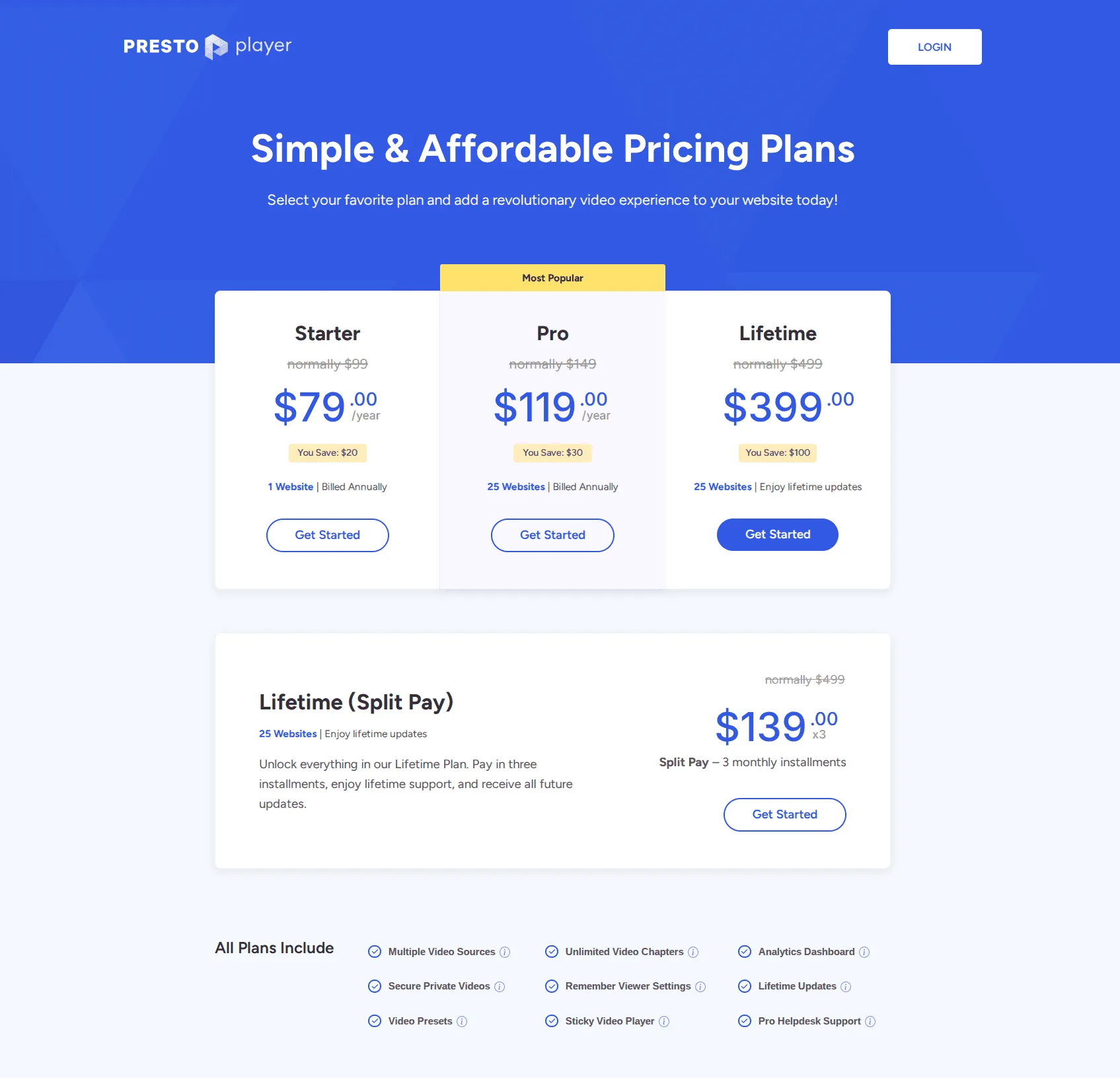 Presto Player requires you to provide your own video hosting alongside their software license.
Marketing tools — chapters, email gates, muted autoplay — are built specifically for the WordPress ecosystem. Version 3.1, released in February 2026 (Presto Player Changelog), added automatic caption generation for Bunny.net-hosted videos, simplifying accessibility compliance. Presto Player is solid software, but setting up separate hosting infrastructure adds complexity.
Pros:
- Deeply integrated with WordPress blocks and page builders
- Solid marketing features (email gates, chapters)
- One-time annual software license rather than monthly SaaS fees
Cons:
- You are responsible for your own video hosting and CDN delivery
- The free tier is heavily limited to basic playback
Pricing: A free basic version is available. Plans start at $79/yr for the single-site Starter license (normally $99/yr), with the 25-site Pro license at $119/yr (normally $149/yr) — but you must factor in your external hosting costs.
8. Jetpack VideoPress (Basic WordPress Video)
Built by Automattic (the company behind WordPress.com), Jetpack VideoPress is bundled with the broader Jetpack plugin. It offers a basic, ad-free player specifically for WordPress sites.
It handles automatic transcoding and delivers videos without ads, but lacks the advanced marketing tools, custom branding, and speed optimizations found in dedicated platforms. VideoPress is on version 3.3 as of August 2026, tested up to WordPress 7.0.4 (WordPress.org), though releases remain mostly maintenance and compatibility work rather than new features.
Pros:
- Integrated naturally into the WordPress ecosystem
- Ad-free and simple to use
Cons:
- Requires installing the heavy Jetpack plugin suite
- Strict 1TB total storage cap on paid tiers
- Very limited player customization
Pricing: The free tier allows exactly 1 video. The paid tier is $9.95/mo (billed yearly; $4.95/mo for the first year with the 50% intro discount, all renewals at full price).
What Are the Best YouTube Alternatives for Creators?
The best YouTube alternatives for creators are TikTok for short-form discovery and Twitch or Kick for live streaming — platforms whose algorithms actively push new content to new viewers.
If you are a creator, influencer, or live streamer, your goals are completely different. You need platforms with aggressive algorithms that put your content in front of new eyeballs. Here is where the creator economy stands in 2026.
9. TikTok (Best for Short-Form Discovery)
TikTok is no longer just a competitor; it is the dominant force in mobile-first video. With over 1.5 billion monthly active users globally (Statista, 2025), it has permanently altered how discovery works online. After years of regulatory uncertainty in the U.S., TikTok’s American operations were restructured in January 2026 under a joint venture led by Oracle, Silver Lake, and MGX, with ByteDance retaining a minority stake under national security oversight (TechCrunch, 2026).
For brands and creators, TikTok serves the exact same purpose as YouTube: algorithmic reach. You post here to get discovered by strangers. However, just like YouTube, you cannot meaningfully use TikTok to embed videos on your own landing pages—the embeds are built for social sharing, not professional presentation.
10. Twitch & Kick (Best for Live Communities)
For live streamers, YouTube Live faces competition from Twitch and the fast-growing platform Kick. Twitch maintains over 240 million monthly active users (Backlinko, 2026) and remains the epicenter of gaming and interactive live streams. In May 2026, Twitch opened its monetization tools—subscriptions, Bits, emotes, badges and Channel Points—to all streamers regardless of follower count, first in the US and then globally. The catch: streamers still have to earn Affiliate or Partner status before Twitch will pay out.
Kick crossed the 100 million registered user mark in early 2026 (Streams Charts, 2026). The growth is driven by an aggressive 95/5 revenue split that favors creators over the platform. Both platforms are effective for building and monetizing a loyal live audience, but neither is suitable for hosting VOD (Video on Demand) content on a company website.
Which YouTube Alternative Should You Choose in 2026?
The right platform depends on where your video needs to live: use a dedicated host for video on your own website, a social platform for audience reach, or run both under the Split Strategy.
The global online video platform market is on track to reach $35 billion by 2030 (Grand View Research, 2025). With so much investment pouring into the space, the days of relying on a single platform for everything are over.
If you are a content creator, focus your energy on YouTube, TikTok, and Twitch to maximize your algorithmic reach. But if you are a business owner trying to drive leads, sales, and conversions from your own website, you must adopt the Split Strategy.
Keep using YouTube as a search engine, but stop putting their heavy, ad-filled player on your landing pages. A professional alternative ensures that when you finally get a prospect to your site, they watch your message—not a competitor’s related video.
Honorable Mentions: Dailymotion, Rumble, and Decentralized Platforms
Several other YouTube alternatives appear in every competitor roundup but serve narrower audiences than the platforms above:
- Dailymotion is a major French-owned platform popular among European news publishers. It offers a revenue-sharing model for creators and basic embed tools, but lacks the page-speed optimization and marketing integrations businesses need.
- Rumble has grown rapidly as a creator platform positioned around minimal content moderation. It competes with YouTube for political commentary and independent media but offers limited business hosting features.
- Odysee and PeerTube are decentralized, open-source alternatives built on blockchain and peer-to-peer technology respectively. They appeal to creators focused on censorship resistance and data ownership, but lack the CDN infrastructure, analytics, and enterprise tools businesses require. (See the FAQ below for more on decentralized options.)
Frequently Asked Questions
These are the questions people ask most when comparing YouTube competitors and alternatives.
Is Vimeo or YouTube better for business websites?
Vimeo is significantly better for business websites than YouTube because it provides an ad-free player without related videos linking to competitors. However, commercial video hosting solutions like Vimeo do charge based on bandwidth consumption, whereas YouTube is free but monetizes your audience with advertisements (Wyzowl, 2026).
Which YouTube alternative has no ads?
Most premium B2B platforms, including SmartVideo, Wistia, and SproutVideo, offer completely ad-free video hosting. Unlike social platforms that rely on advertising revenue, these commercial alternatives charge a subscription fee to provide a clean, distraction-free player optimized for website conversions.
What is the best platform for B2B lead generation?
Wistia is widely considered the strongest platform for native B2B lead generation due to its built-in Turnstile email capture and deep integrations with CRMs like HubSpot and Marketo. However, other platforms like Presto Player also offer email gating capabilities for a lower annual cost.
Can I monetize videos without 1,000 subscribers?
Yes, platforms like Patreon, Uscreen, and Thinkific allow you to monetize your video content through direct viewer subscriptions or paywalls regardless of your subscriber count. This bypasses YouTube’s strict Partner Program requirements, which need 1,000 subscribers plus either 4,000 watch hours in 12 months or 10 million qualified Shorts views in 90 days.
Why do YouTube embeds slow down my website?
The default YouTube iframe embed loads roughly 1.2MB of JavaScript, tracking scripts, and thumbnail assets before the viewer even clicks play (documented in Zach Leatherman’s widely cited analysis). This heavy payload severely impacts Core Web Vitals, which is why performance-focused developers prefer lightweight commercial players that use lazy loading and facade patterns.
What are the best decentralized YouTube alternatives?
Odysee (built on the LBRY protocol) and PeerTube are the most prominent decentralized video platforms. They operate using blockchain and peer-to-peer technology to resist centralized censorship, making them popular among creators focused heavily on free speech and data ownership.
Do I need a separate CDN for video hosting?
If you use a managed platform like SmartVideo, Wistia, or Vimeo, a global CDN is already built into the service to ensure fast playback. You only need to configure a separate video CDN if you are building a custom streaming architecture using raw infrastructure tools like Bunny Stream or Amazon CloudFront.
How much does enterprise video hosting cost?
Enterprise platforms like Brightcove and Kaltura require custom annual contracts that start at $1,500 to $3,000 per month, depending on DRM requirements, live event broadcasting needs, and massive bandwidth consumption thresholds.


