
Wistia vs Vimeo: Which Video Hosting Platform Is Right for Your Business? (2026)
Wistia vs Vimeo in 2026: pricing, analytics, live streaming, privacy, and the business use cases where each platform makes sense.


• Best for marketing teams: Wistia is the stronger choice if you want heatmaps, A/B testing, lead capture, and deeper video-specific marketing workflows.
• Best for live events and monetization: Vimeo offers live streaming, webinars, and OTT/pay-per-view options that Wistia does not match natively.
• Big caution in 2026: Vimeo's ownership changed in late 2025, and TechCrunch reported major layoffs on January 22, 2026, including claims that the entire video team was affected (TechCrunch, 2026).
• Best value for business websites: If you need fast, branded, ad-free embeds without paying for Wistia's analytics stack or betting on Vimeo's roadmap, SmartVideo is the cleaner fit.
Wistia vs Vimeo -- which is right for you? Wistia is the stronger platform for marketing-led businesses, while Vimeo is the stronger platform for live events, creative workflows, and OTT monetization. If your main job is turning video into leads on your site, pick Wistia. If you need webinars, streaming, or subscription video products, pick Vimeo. If you mostly need ad-free website embeds that load fast and stay affordable, there is a third option worth considering.
That distinction matters because video is now standard business infrastructure, not a side project. According to Wyzowl's 2026 survey, 91% of businesses use video as a marketing tool and 82% of marketers say video gives them good ROI (Wyzowl, 2026). The platform you choose affects your costs, page speed, analytics depth, and how much control you keep over the viewer experience.
How do Wistia and Vimeo compare at a glance?
Wistia wins on marketing analytics, while Vimeo wins on live streaming and monetization. This summary table covers pricing, features, and risk.
| Category | Wistia | Vimeo | Who wins? |
|---|---|---|---|
| Core strength | Video marketing and conversion analytics | Creative hosting, live events, and OTT | Tie, depending on use case |
| Starting point | Free plan, then Business at $79/mo annually | Free plan, then Starter at $12/mo annually | Vimeo on entry price |
| Heatmaps and viewer behavior | Native heatmaps and A/B tests | Broader analytics, less specialized for conversion testing | Wistia |
| Live streaming and webinars | Available as a separate webinar product | Built into Advanced and Enterprise | Vimeo |
| Monetization | No native OTT or PPV product | Vimeo OTT supports subscriptions and pay-per-view | Vimeo |
| Business risk in 2026 | Stable marketing-focused direction | Post-acquisition uncertainty after January 2026 layoffs | Wistia |
What are the real differences between Wistia and Vimeo?
Wistia is a marketing-first video platform, while Vimeo is a broader creation and hosting suite. That core difference shapes everything from analytics depth to pricing structure.
Wistia is built for marketers who care about what viewers do next
Wistia treats video as a conversion asset. Its official docs highlight heatmaps that show second-by-second viewing behavior, plus A/B testing for comparing video versions and built-in CTAs inside the player. That matters if your videos sit on landing pages, product pages, or nurture flows and you need to know where viewers drop off.
This is why Wistia wins so often for B2B SaaS, agencies, and marketing teams. The platform is opinionated in a useful way: it assumes you want better play rate, better engagement, and more conversions, not just a clean player.
Vimeo is broader, with more creation, streaming, and selling options
Vimeo covers more categories than Wistia. Its current plan structure includes Starter, Standard, Advanced, and Enterprise, with live events and webinars included at the higher end (Vimeo Help Center, 2026). Vimeo also has a separate OTT/pay-per-view product for creators and businesses that want subscriptions or event sales.
From what we've seen working with businesses migrating between platforms, that makes Vimeo more flexible if your needs extend beyond website embeds. A business running webinars, shipping recorded training, and selling access to events can do more inside one ecosystem with Vimeo than with Wistia.
How much do Wistia and Vimeo cost in 2026?
Wistia's pricing is simpler with fewer tiers, while Vimeo offers more entry points across a wider range of budgets. Both changed their plans in the last year.
Wistia pricing is straightforward, but it gets expensive fast
As of May 12, 2026, Wistia's pricing page lists a free tier with 25 GB of storage, 200 GB of bandwidth, and 1 user. Paid plans jump to Business at $79/month billed annually, which includes 250 GB+ storage, 1 TB bandwidth, and 3+ users, with extra users billed separately.
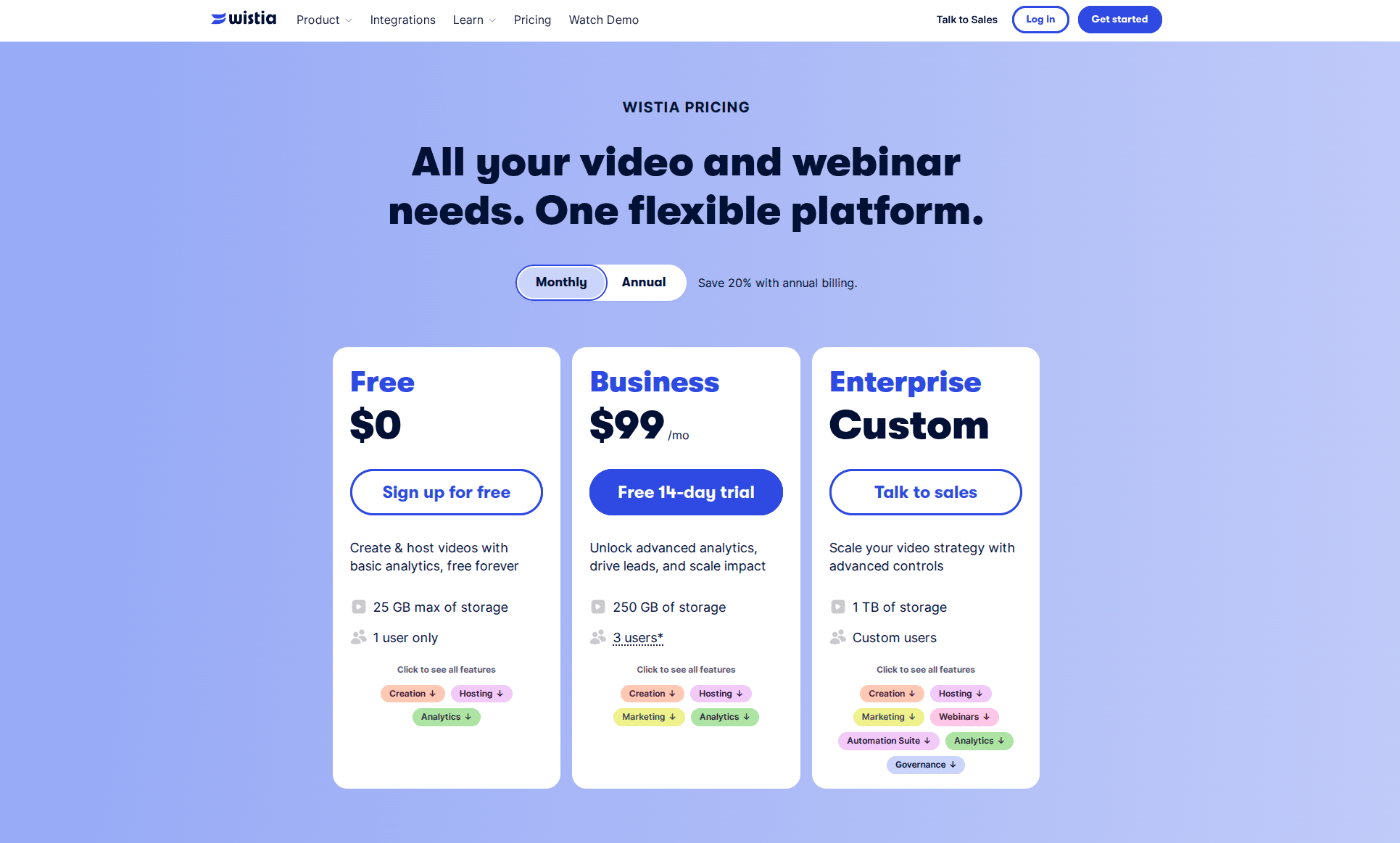
Pros: clear packaging, strong analytics, and fewer plan choices. Cons: the jump from free to paid is steep for small businesses, and some advanced marketing workflows become meaningfully more expensive once you add users and automation.
Vimeo pricing has more entry points, but the trade-offs are harder to read
Vimeo's public pricing pages currently show a wider ladder. Pages indexed from Vimeo in May 2026 show Starter at $12/month billed annually, Standard at $25/month billed annually, and Advanced at $75/month billed annually on some feature pages, while Vimeo's help docs confirm those are the active self-serve tiers and that monthly billing is available for Starter, Standard, and Advanced (Vimeo pricing, 2026).
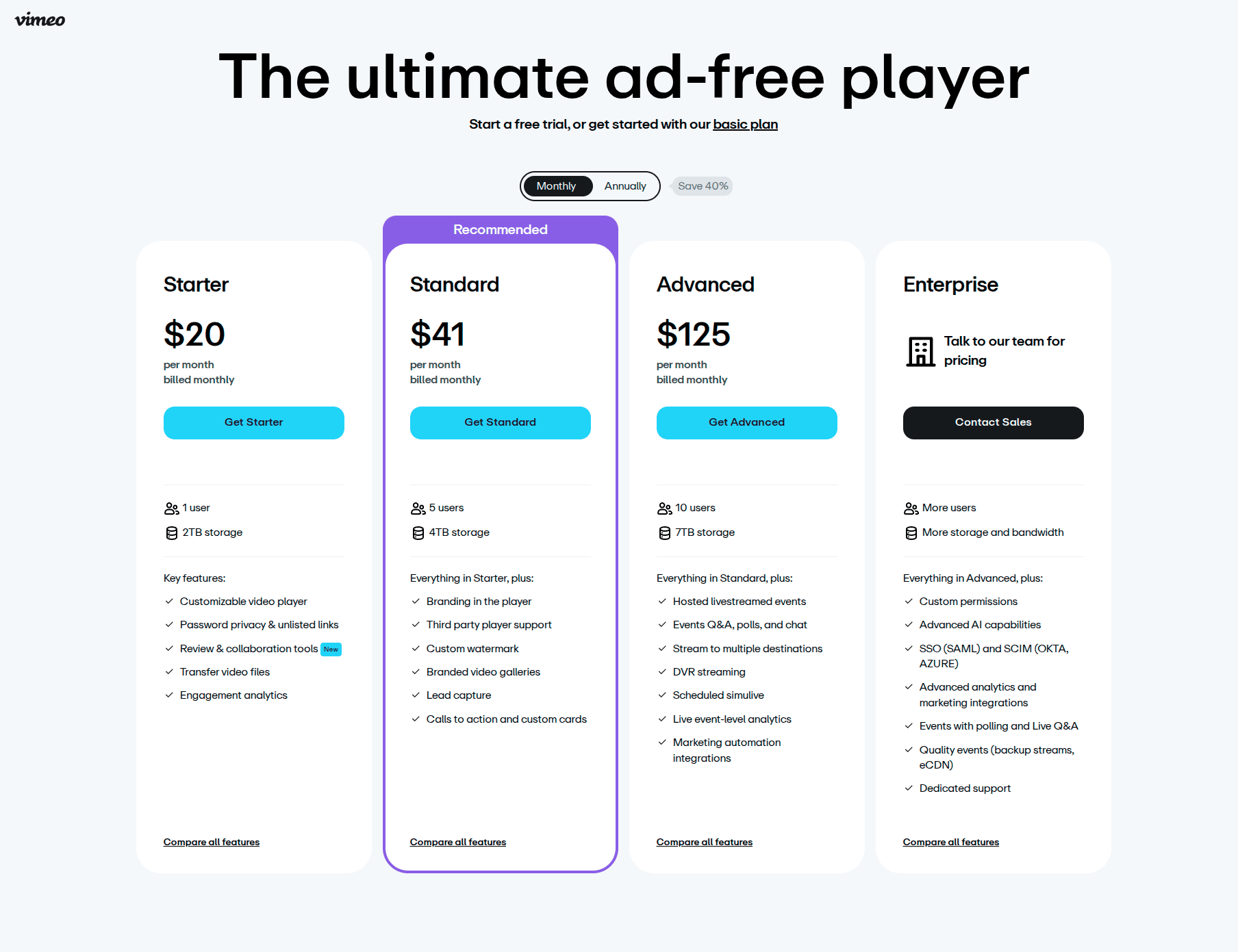
That broader lineup is attractive if you want a lower entry price than Wistia. The catch is that Vimeo's value depends heavily on which features you need. If you only want business video hosting for your site, you can end up paying for creation, collaboration, or live features you may never use. If you are already researching Vimeo's bandwidth limits and pricing, read the fine print before you commit.
Which platform wins on features?
Wistia wins on marketing analytics and CRM integration. Vimeo wins on live streaming, monetization, and creative tools. Here is how each category breaks down.
Analytics and CRM integrations: Wistia has the sharper business toolkit
In our experience helping businesses choose video hosts, Wistia's analytics stack is still the clearest differentiator. Heatmaps show exactly which sections people watched, rewatched, or skipped, and A/B testing lets you compare thumbnails, CTAs, or even whole videos inside a live embed. For marketing teams, that is more actionable than broad engagement dashboards.
We see this trade-off often: teams say they want "video hosting," but what they really want is a way to improve conversions from product explainers, demos, and case studies. In that scenario, Wistia is easier to justify than Vimeo, especially if you're already feeding data into HubSpot or Marketo.

Live streaming and webinars: Vimeo is the more complete option
Vimeo has the cleaner story for live video. Its Advanced plan includes event broadcasting tools, simulcasting, audience chat, Q&A, polls, and webinar registration. Wistia supports webinars too, but it is sold as a separate product, with plans starting at $350/month billed annually on top of a required Business plan.
That means Vimeo wins if live events are central to your business. A small marketing team that runs monthly webinars will spend less effort piecing things together inside Vimeo than inside Wistia.
Monetization and online courses: Vimeo offers more native routes
If your goal is to sell access to video content, Vimeo has an advantage because Vimeo OTT supports subscription and transaction models out of the box. Wistia does not try to be an OTT commerce platform.
That said, course creators should not stop the comparison there. Ownership and support stability matter when your revenue depends on your video stack. If you're evaluating hosted course delivery, this is also where our post on why course creators are switching away from Vimeo becomes relevant.
SmartVideo starts at $19/month annually with branded, ad-free embeds, CDN delivery, and no distraction-heavy player ecosystem. See why businesses are switching from Vimeo.
AI features and localization: both have AI, but for different jobs
Wistia's AI push is more useful for distributed marketing and training teams. Its AI video localization product offers dubbing, lip sync, transcription, and translations in more than 50 languages. Vimeo's AI tools lean more toward script generation and teleprompter workflows.
If your team publishes one core explainer in multiple markets, Wistia's localization angle is more compelling. If your team records lots of talking-head content and wants help drafting scripts, Vimeo's teleprompter workflow is more practical.
Privacy, embeds, and page performance: this depends on what lives on your site
Both platforms support ad-free embeds and privacy controls that are stronger than YouTube. Vimeo offers domain-level privacy on paid plans, and Wistia gives you extensive player customization. The real difference is how much business value you need from the embed itself.
In our testing, this is where heavier all-in-one platforms can become awkward for business websites. If your site needs a fast, branded player first and a media suite second, a focused host is often the better fit. That's also why posts like how video load speed affects conversions and best business video hosting platforms matter more than generic feature checklists.
Is Vimeo still safe to use after the Bending Spoons acquisition?
Vimeo still works, but the platform carries more execution risk in 2026 than at any point in its history. This is the biggest issue competitors keep glossing over. TechCrunch reported on January 25, 2026 that Vimeo's layoffs had affected most of the workforce, including claims that the entire video team was gone, following the acquisition by Bending Spoons and layoffs that began on January 22, 2026.

That does not mean Vimeo will fail. We've watched this pattern play out with other acquisitions in the hosting space, and it does mean buyers should ask harder questions about roadmap continuity, support quality, and pricing direction in 2026. If you're choosing a host for a course library, member site, or customer education hub, platform stability is part of the buying decision, not a side note.
Who should choose Wistia, Vimeo, or SmartVideo?
Your right platform depends on your specific use case. Here is how each option maps to common business scenarios.
| Use case | Best fit | Why |
|---|---|---|
| B2B marketing team | Wistia | Heatmaps, A/B tests, CTAs, and lead-oriented workflows justify the price. |
| Webinar-heavy business | Vimeo | Live broadcasting and webinar tooling are more central to the product. |
| Course creator or membership site | Vimeo, with caution | OTT and monetization help, but ownership and support risk are real in 2026. |
| Agency or small business website | SmartVideo | You get branded, fast embeds without paying for a bigger media stack than you need. |
| Ecommerce product video | Wistia or SmartVideo | Pick Wistia for conversion analytics; pick SmartVideo for speed and lower ongoing cost. |
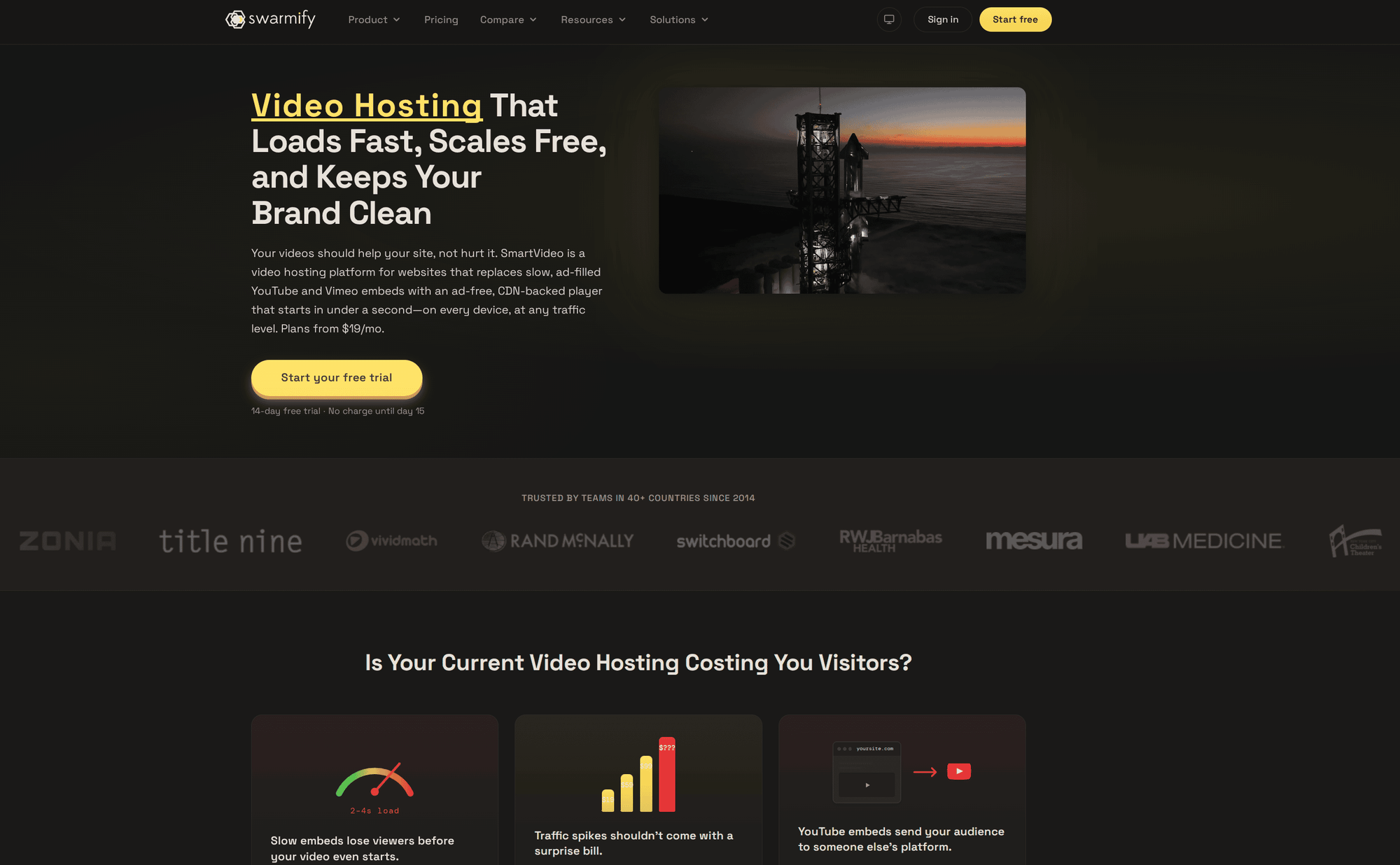
If you want the shortest version of the verdict, it is this: Wistia is worth paying for when video is part of your marketing measurement stack. Vimeo is worth paying for when live delivery or monetization is central to your business. SmartVideo is worth paying for when your main need is fast, branded, ad-free business video hosting on your own website.
Frequently asked questions about Wistia vs Vimeo
Is Wistia better than Vimeo?
What is the difference between Wistia and Vimeo?
Is Wistia worth the price for small businesses?
Does Wistia have a free plan?
Does Vimeo have ads on embedded videos?
Which platform is better for video analytics: Wistia or Vimeo?
Can you use Wistia or Vimeo for online courses?
What happened to Vimeo after Bending Spoons acquired it?
Is there a cheaper alternative to Wistia and Vimeo?
Final verdict
Choose Wistia if video is part of your marketing measurement system. Choose Vimeo if you need live events or want to build around OTT and paid access. If you need business video hosting that stays fast on your site, keeps embeds distraction-free, and costs less than either platform at the entry level, SmartVideo is the cleaner option for most business websites.