
9 Brightcove Alternatives for Video Hosting in 2026
An honest comparison of Brightcove alternatives for teams that want better pricing clarity, easier embeds, and a better fit in 2026.


• Best overall shortlist: The strongest Brightcove alternatives for 2026 are Vimeo, Wistia, Dacast, JW Player, Panopto, Uscreen, Bunny Stream, SproutVideo, and SmartVideo.
• Why companies switch: Brightcove is still capable, but many teams want more pricing clarity, less implementation overhead, and a platform that matches their actual workflow.
• What matters most: Compare on live streaming, OTT monetization, analytics, privacy controls, embed quality, and how much platform complexity your team can absorb.
• Fast recommendation: If you need enterprise media operations, start with Vimeo, Dacast, JW Player, or Panopto. If you mainly need clean website video hosting, look at Wistia, SproutVideo, or SmartVideo.
The top Brightcove alternatives in 2026 depend on why you are leaving, but most buyers should start with Vimeo, Wistia, Dacast, JW Player, Panopto, Uscreen, Bunny Stream, SproutVideo, and SmartVideo. Brightcove still covers large-scale live streaming, analytics, and monetization well, but many teams do not need that level of enterprise weight or quote-based pricing for everyday website video.
That is the real split in this market. Some companies need a Brightcove replacement for OTT, internal communications, or live events. Others searched for brightcove alternatives because they are paying enterprise-platform prices to host marketing videos, product demos, training clips, or private embeds on their site. Those are different buying decisions, and most comparison posts blur them together.
How we evaluated: We compared these platforms across seven criteria that matter most in Brightcove migrations: pricing transparency, live streaming capability, OTT monetization, analytics depth, privacy and access controls, embed quality and site performance, and implementation complexity. Rankings reflect fit for the most common buyer profiles, not a single scoring formula -- because a platform that is ideal for OTT operators may be wrong for a marketing team embedding product demos.
If you want the short answer first, here is the ordered shortlist based on fit for pricing transparency, website embeds, privacy, live streaming, OTT support, analytics depth, and implementation complexity:
- Vimeo
- Wistia
- Dacast
- JW Player
- Panopto
- Uscreen
- SmartVideo
- Bunny Stream
- SproutVideo
Quick Comparison Table
| Platform | Strongest Fit | Pricing Signal | What It Does Well | Main Watchout |
|---|---|---|---|---|
| Vimeo | Business video teams that still want enterprise workflows | Starter from $12/mo annual; enterprise is quote-based | Brand control, privacy, events, integrations | Bandwidth limits on lower plans |
| Wistia | Marketing and demand-gen teams | Free tier, then $79/mo Business | Lead capture, clean embeds, analytics | Expensive jump from free to paid |
| Dacast | Live streaming and OTT operators | Public pricing page | Live events, monetization, API access | Less polished for pure marketing-site use |
| JW Player | Publishers and ad-supported video businesses | Contact sales | Player tech, delivery, monetization stack | Not the simplest option for small teams |
| Panopto | Internal training and enterprise knowledge video | Request a demo | Searchable internal libraries, governance, webcast delivery | Overkill for public-facing marketing sites |
| Uscreen | Subscription video and membership businesses | Public plans plus add-ons | OTT apps, memberships, community | Built for monetization, not simple website embeds |
| SmartVideo | Business websites that need fast, branded, ad-free playback | Startup $19/mo annual, Growth $59/mo annual | Unlimited bandwidth, WordPress-native embeds, predictable plans | Not trying to be a full OTT operating system |
| Bunny Stream | Developers who want low-cost infrastructure | Usage-based from about $1/mo | Low entry cost, CDN footprint, API-friendly | Developer-oriented setup |
| SproutVideo | Private business video and lighter portals | Starts at $10/mo | Privacy controls, simple hosting, CTAs | Seed plan has tight video and bandwidth caps |
Why Buyers Look for Brightcove Alternatives
Brightcove is still a serious enterprise platform. Its product messaging centers on live events, OTT monetization, communications, marketing, and app distribution (Brightcove, 2026). If you run large-scale streaming or need a wide product surface across business units, that can be the right answer.

But many teams leave Brightcove for simpler reasons. They want pricing they can see before a sales call. They want easier embeds. They want a player that works well on a marketing site without dragging in a bigger media stack than they need. They also want cleaner separation between use cases: public marketing video, internal comms, course delivery, and OTT monetization are not the same problem.
That matters because 89% of businesses use video as a marketing tool and 93% of marketers say video gives them a good ROI (Wyzowl, 2025). Video has moved out of the specialist bucket. When more teams inside a company need video, expensive and opaque tooling gets harder to justify.
Viewer expectations also keep rising. In the U.S., TV became the primary device for YouTube viewing by watch time, and viewers globally watch more than 1 billion hours of YouTube on TVs each day (YouTube Blog, 2025). If playback quality is the bar your audience sees elsewhere, sluggish on-site embeds stand out fast.
We have seen this play out in migrations: the sticking point is often not feature parity on paper, but whether the replacement fits the actual workflow. A team hosting webinars, product demos, gated landing-page videos, and a few private training clips does not need the same system as a media company running 24/7 channels.
The 9 Top Brightcove Alternatives
1. Vimeo
Vimeo is the closest broad business-video alternative if you still want an established platform with privacy controls, events, branded playback, and enterprise add-ons. Vimeo positions its enterprise product around centralized administration, analytics, SSO, governance, and live events (Vimeo, 2026), which puts it in familiar territory for Brightcove buyers.
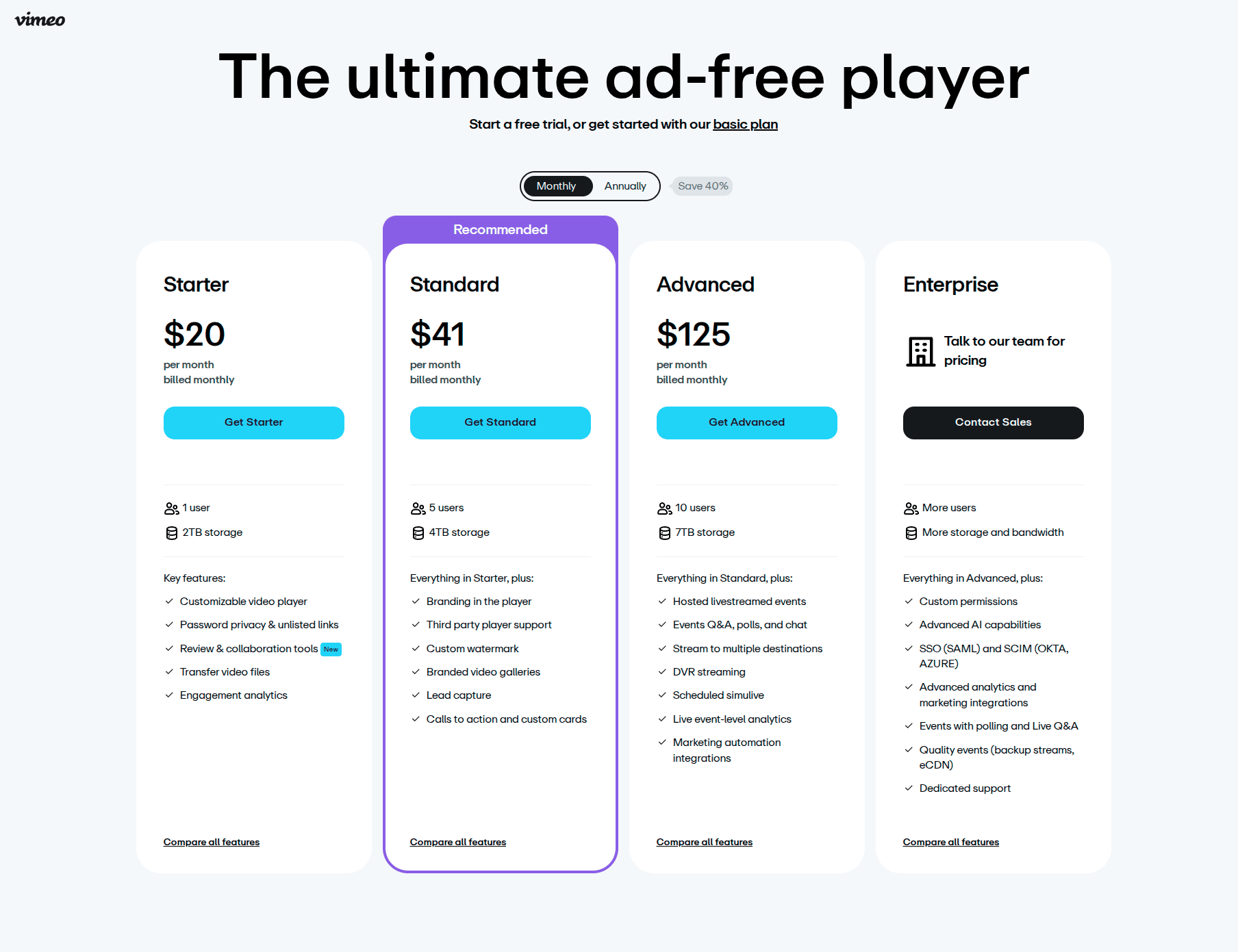
Pros: Strong brand recognition, polished player, privacy controls, and a wide spread of business features. Cons: Vimeo’s lower plans are easier to buy than Brightcove, but bandwidth-based packaging is still a real budgeting issue. The current public pricing starts at $12/month annually for Starter, but that plan is capped at 2TB per year, so heavier usage pushes you upmarket quickly.
In our experience helping teams migrate from enterprise platforms, Vimeo’s bandwidth model is the single biggest surprise for buyers who assume flat-rate pricing means flat-rate at scale. It does not.
Pick Vimeo if you want a mainstream business platform and can live with the bandwidth model. Skip it if predictable usage costs are a non-negotiable requirement.
2. Wistia
Wistia is a cleaner fit than Brightcove for marketing teams that care about embeds, lead capture, email gates, and presentation. Wistia’s hosting product leans into ad-free playback, fast loading, analytics, and player customization (Wistia, 2026), which is why it often wins with SaaS, agency, and demand-gen teams.
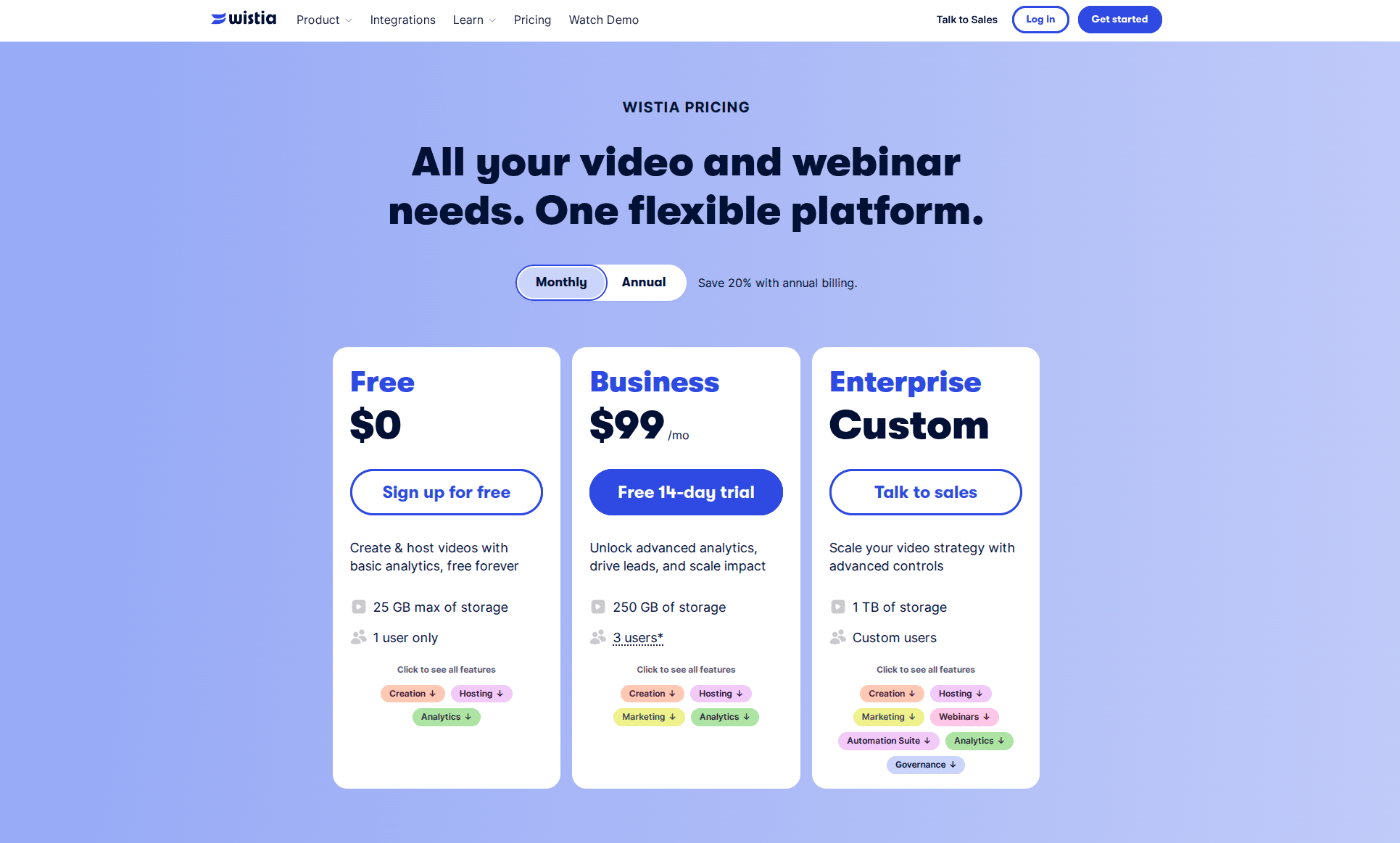
Pros: Great for website video, simple user experience, and analytics that make sense to marketers. Cons: The pricing ladder is blunt. Wistia’s free tier only includes 3 videos with branding, and paid plans jump to $79/month for Business. If you need internal training, OTT, or big live streaming operations, it is not trying to be Brightcove.
We have tested Wistia's embed performance side by side with other players on this list, and its page weight and start times are noticeably lighter than Brightcove's default player. This is one of the strongest options if your Brightcove account mainly exists to support marketing videos. If that is your use case, read our broader guide to Wistia alternatives too, because the same trade-offs appear one tier down.
3. Dacast
Dacast belongs on the shortlist if live streaming and monetization matter more than polished marketing-site workflows. Its public pricing and product positioning focus on live streaming, video hosting, OTT delivery, APIs, and monetization, which makes it a practical Brightcove replacement for event-heavy or media-like operations (Dacast, 2026).
Pros: Better pricing transparency than Brightcove, solid live-streaming orientation, API options, and monetization support. Cons: The product feels more infrastructure-forward than marketer-friendly. If your team mainly embeds video on landing pages or product pages, it can be more platform than you need.
Dacast is a strong option when Brightcove is justified for the business problem but the contract, overhead, or pricing process is not.
4. JW Player
JW Player makes the most sense for publishers, ad-supported video businesses, and teams that care about player technology as much as hosting. Its pricing page groups the offering around video delivery, live, analytics, and monetization rather than simple business hosting (JW Player, 2026), which is a clue about the intended buyer.
Pros: Mature player heritage, monetization tooling, and a delivery stack built for high-volume video operations. Cons: It is not the easiest platform for a small business marketing team that just wants uploads, clean embeds, and predictable packaging.
If Brightcove appealed to you because it felt close to publisher infrastructure, JW Player is one of the more credible replacements. If Brightcove felt bloated, JW Player will not solve that complaint.
5. Panopto
Panopto is the bright-line alternative for internal communications, training, lecture capture, and enterprise video libraries. Panopto emphasizes video delivery over standard web traffic, HLS-based playback, scalable internal distribution, and easier enterprise video management across networks (Panopto, 2026).
Pros: Better fit for searchable internal video, employee communications, and knowledge repositories. Cons: If your problem is public website video, Panopto is the wrong shape. It solves a different operational problem.
We have seen teams waste months comparing public hosting platforms when their real requirement was governed internal video with search, permissions, and compliance. In our work with enterprise and education customers, this mismatch is one of the most common evaluation mistakes. In that case, Panopto deserves to move near the top of the list.
6. Uscreen
Uscreen is not a Brightcove clone, and that is exactly why some buyers should prefer it. Uscreen is built around memberships, video libraries, community, direct livestreams, and app distribution (Uscreen, 2026). If your business model is subscription content, courses, coaching, or creator-led membership video, that matters more than enterprise comms features.
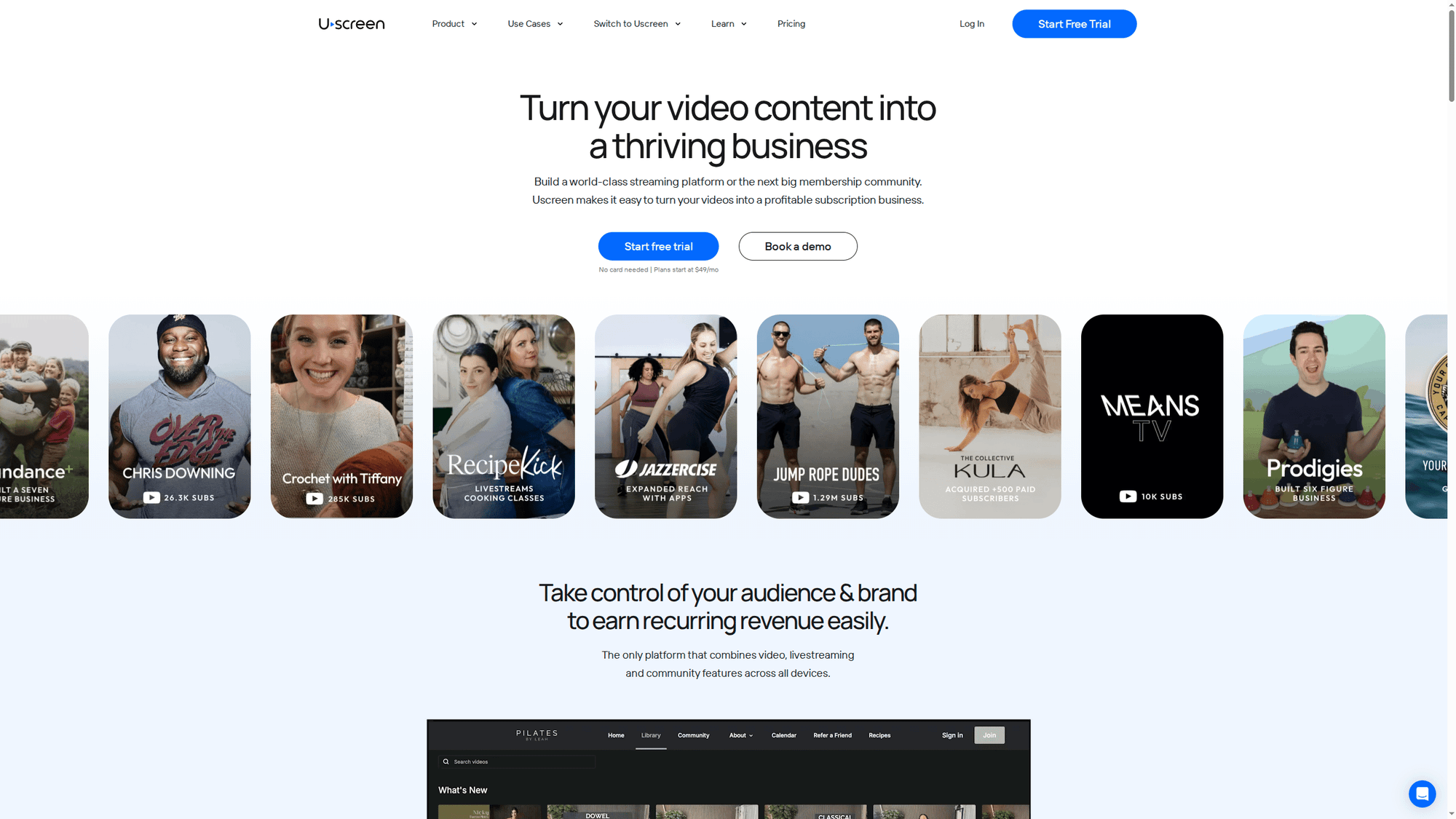
Pros: Better fit for subscription video businesses, strong OTT direction, and a product built around audience monetization rather than generic hosting. Cons: If you only need private embeds on a company website, it adds a lot you will never use.
Pick Uscreen when you care about monetized audience relationships and owned apps. Skip it for plain business website hosting.
7. SmartVideo
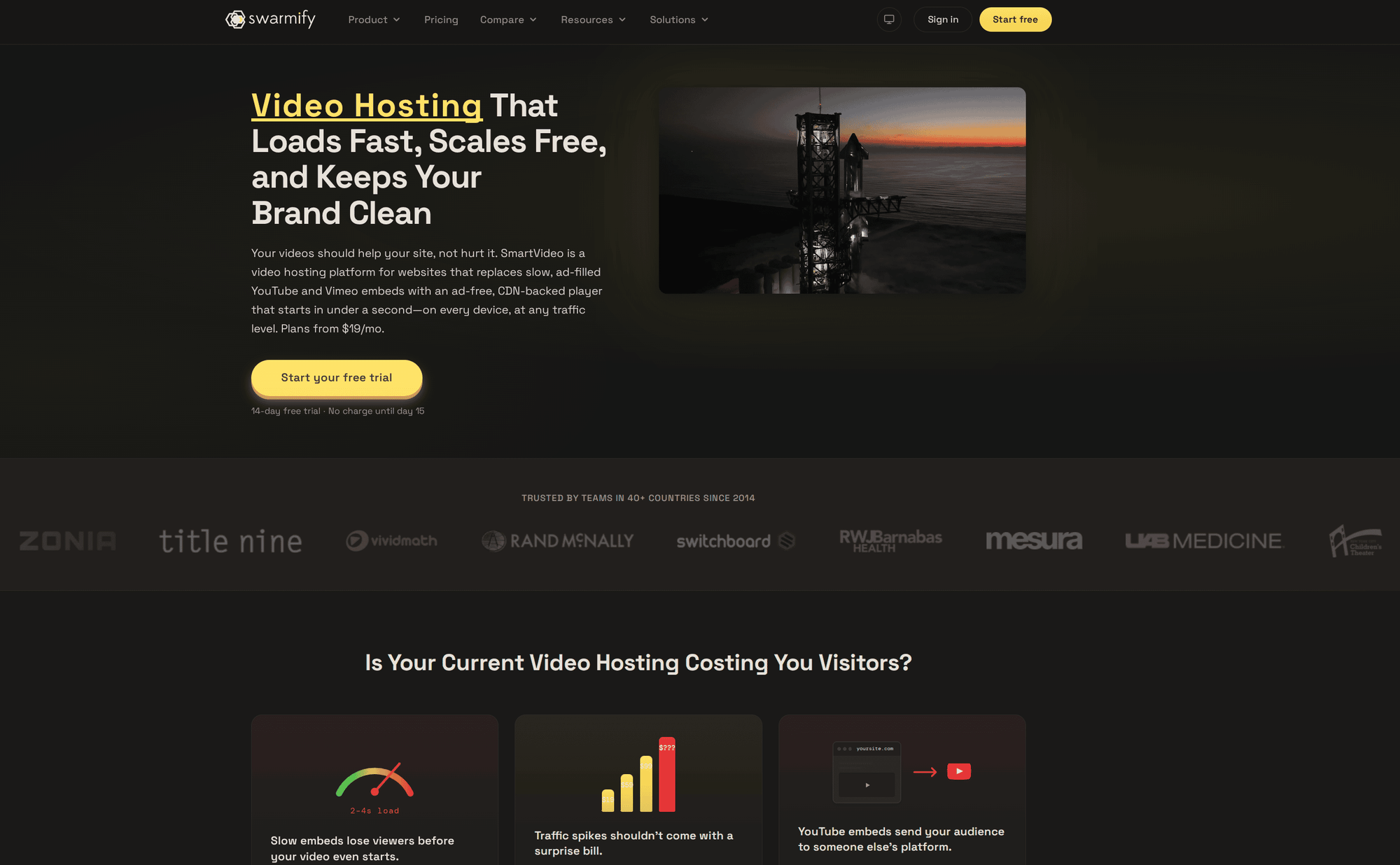
SmartVideo is the right Brightcove alternative when your real requirement is fast, branded, ad-free video on a business website, not an all-in-one enterprise media stack. It is built for website embeds, with a WordPress plugin, shortcode and block support, script-snippet installs for other platforms, adaptive streaming, lazy loading, and CDN delivery.
Pros: Predictable plans, unlimited bandwidth on every tier, branded playback, and a setup that fits website owners instead of broadcast teams. Cons: It is not trying to run your OTT app business or replace every enterprise workflow Brightcove can touch. SmartVideo starts at $19/month annually for Startup and $59/month annually for Growth, which includes 50,000 monthly views, 2TB storage, and unlimited bandwidth.
If your Brightcove account exists because you need clean embeds, privacy, better start times, and fewer moving parts, SmartVideo is often the sharper fit. The migration conversation becomes much simpler when you stop assuming you need a second enterprise suite and start asking what the site actually needs.
Brightcove-level complexity is expensive if your real goal is fast, branded, ad-free playback on your own site. See how SmartVideo handles business video hosting and decide if a simpler setup fits your workflow.
8. Bunny Stream
Bunny Stream is the budget-leaning infrastructure option. Its appeal is simple: low entry cost, CDN reach, and a usage-based model that developers can wire into broader systems (Bunny.net, 2026). It can be a strong Brightcove alternative when price and technical control matter more than a polished business UI.
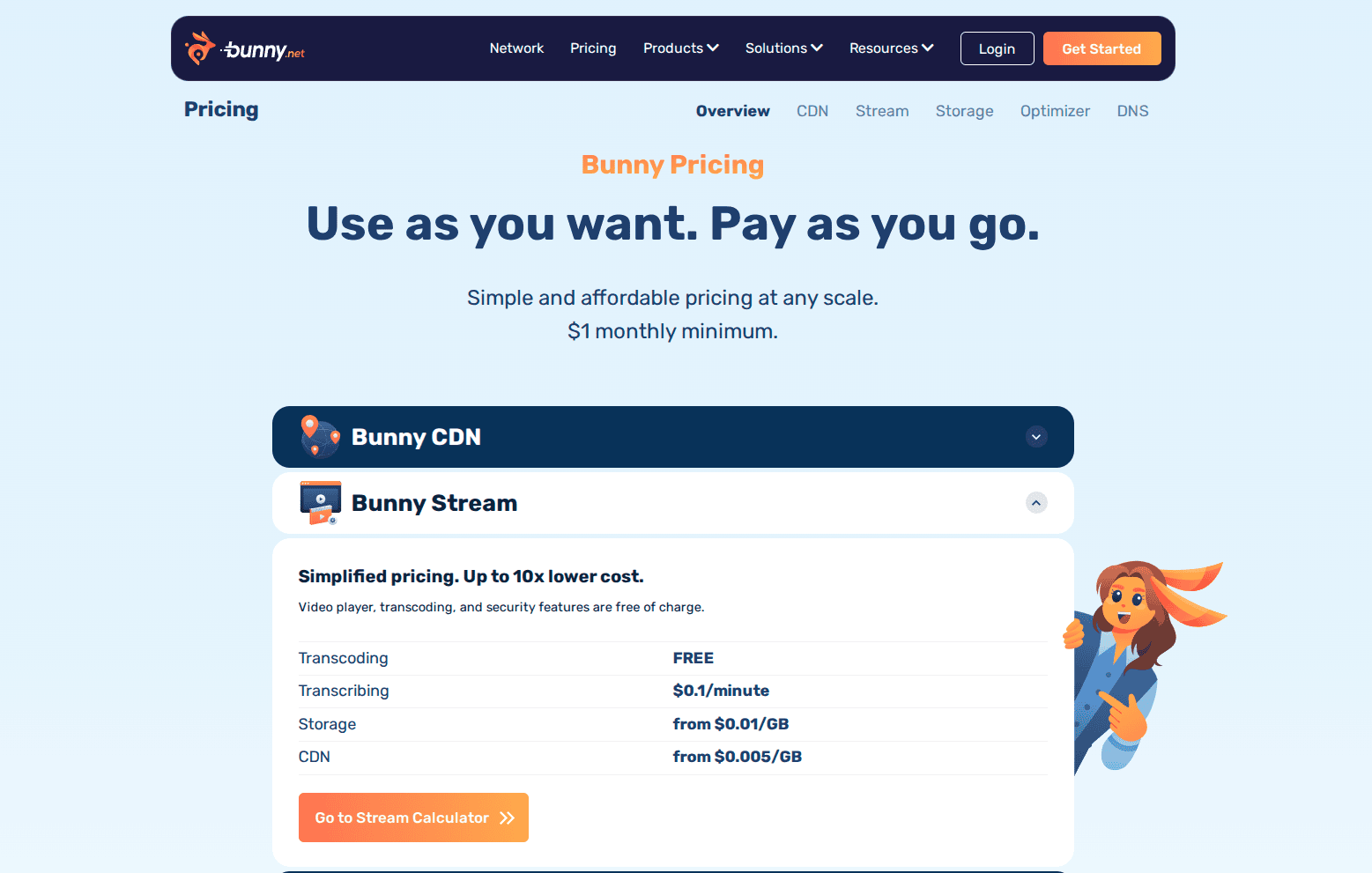
Pros: Low starting cost, API-friendly architecture, and flexibility. Cons: No WordPress-native experience, less business-user polish, and more implementation work. The public pricing is usage-based and starts around $1 per month for low usage, which looks attractive until you factor in developer time and missing convenience features.
We have worked with customers who moved from enterprise platforms to Bunny Stream and saved significantly, but only when they had internal dev resources to handle the integration. This is a good option for engineering-led teams. It is a poor option for a marketing department that wants to stop thinking about video infrastructure.
9. SproutVideo
SproutVideo sits in the middle: lighter than Brightcove, more business-focused than raw infrastructure, and stronger on privacy than public-video platforms. Its pricing and feature set center on video hosting, private sharing, CTAs, and business video controls (SproutVideo, 2026).
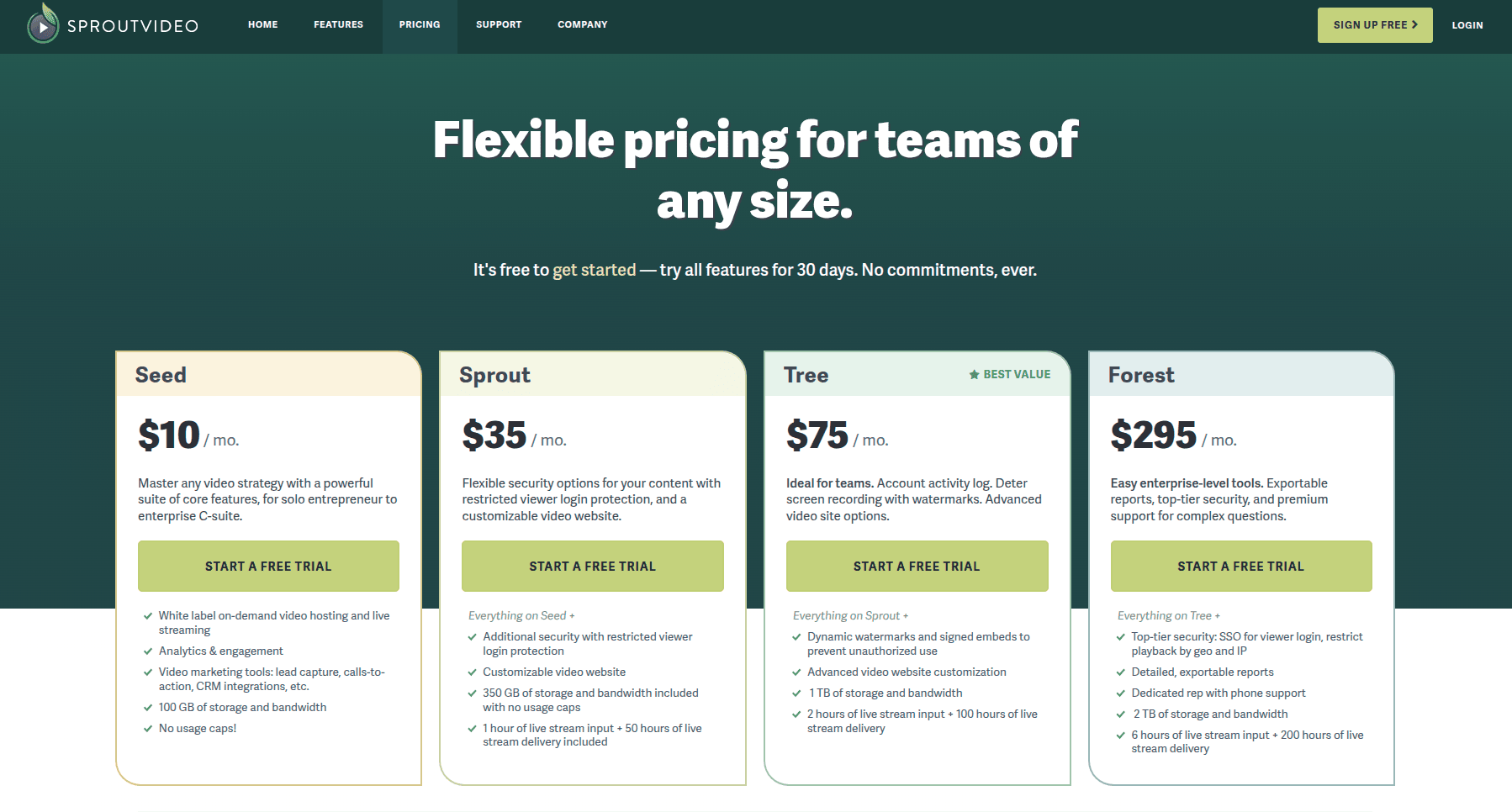
Pros: Straightforward setup, solid privacy options, and a lower entry point than enterprise platforms. Cons: The entry plan starts at $10/month but includes only 25 videos and 500GB of bandwidth, so you need to watch scale. It is not a strong OTT replacement, and it is not meant to be.
If your Brightcove contract feels oversized for what you actually do, SproutVideo is one of the easier downsizing moves.
Brightcove vs Vimeo vs Wistia vs SmartVideo
This is the decision many buyers are actually making, so it is worth separating it from the broader list.
Brightcove fits organizations that need depth across multiple video programs: live events, analytics, OTT, internal comms, and cross-team governance. If several departments rely on one central platform and you can support the implementation overhead, that breadth matters.
Vimeo is the smoother move when you still want a broad business-video platform but need an easier buying motion and a simpler user experience. It stays closer to Brightcove than Wistia does, though the bandwidth model can make budgeting less predictable over time.
Wistia is the better answer when the core goal is marketing video on your site. It is easier to manage than Brightcove, but it also narrows the scope. You give up some enterprise depth and gain a product that makes more sense to a demand-gen or content team.
SmartVideo is the better answer when playback on your website is the problem you need to fix. In that case, player weight, buffering risk, privacy, branding, and WordPress support are more important than OTT tooling. If that is your path, our guides to video hosting platforms for business, choosing a video platform for your website, and embedding video without ads will help you sanity-check the trade-offs.
How to Choose the Right Brightcove Alternative
Start with the workload, not the logo list. A useful shortlist comes from answering five questions:
- Do you need OTT monetization, or just hosting? If you need subscriptions, apps, or transactional video, look at Uscreen, Dacast, or JW Player before lighter tools.
- Is live streaming a main use case? Brightcove is strong here, so do not replace it with a platform that is mostly VOD-focused if live events drive revenue or communications.
- How important is website embed quality? This is where many posts stay too generic. Ad-free playback, fast starts, and tight player control matter if video lives on landing pages or product pages. Our articles on video CDN delivery and the real cost of YouTube embeds go deeper on why the delivery layer affects conversion and user experience.
- Who will run the platform? Developer-friendly and marketer-friendly are not the same thing. Bunny Stream is cost-efficient, but the time cost sits on your team.
- What will migration really involve? Asset transfer is only one piece. You also need to replace embeds, preserve access control, decide what happens to analytics history, and test playback anywhere your existing Brightcove player appears.
Captions and accessibility deserve a line item too. Caption use in videos rose 572% since 2021 (Wistia, 2025), which is a useful reminder that accessibility is not a side feature anymore. If captions, transcripts, privacy, and internal permissions matter, score them explicitly in your evaluation sheet instead of treating them as afterthoughts.
From our own migration work, the quiet risk is embed replacement. Teams budget for moving files but miss the site update. If Brightcove videos are spread across WordPress pages, landing pages, help docs, knowledge bases, and gated content, the safer move is to inventory every player location first. That step alone can change which alternative is realistic.
When Brightcove Is Still the Right Choice
A credible comparison should say this plainly: Brightcove still makes sense for some organizations. If your business needs large-scale live delivery, OTT monetization, deep enterprise controls, and multiple business units on one platform, switching just to save money can backfire.
Brightcove is also still justified when migration risk is higher than contract pain. If you have years of embedded assets, analytics dependencies, access-control rules, and internal workflows built around the platform, the cheapest-looking alternative may turn into the most expensive project.
But if Brightcove is mostly being used as expensive storage plus embeds, that is where the overkill argument becomes hard to ignore. Buyers in that situation should also compare the market more broadly through our guides to private video hosting, Vimeo alternatives, and WordPress video hosting.
FAQ
What are the top Brightcove alternatives in 2026?
Why do companies switch from Brightcove?
Which Brightcove alternative is best for small businesses?
Which Brightcove alternative is best for enterprise video hosting?
Is there a cheaper alternative to Brightcove?
Which Brightcove alternative is best for live streaming?
Which Brightcove alternative is best for OTT or subscription video?
Brightcove vs Vimeo: which is better for business video hosting?
Brightcove vs Wistia: which is better for marketing teams?
How hard is it to migrate away from Brightcove?
Conclusion
There is no single Brightcove replacement for every buyer. The right move is to match the platform to the workload: Vimeo, Dacast, JW Player, and Panopto for broader enterprise video needs; Uscreen for subscription video; Wistia, SproutVideo, and SmartVideo for simpler business hosting; Bunny Stream for developer-led cost control. If your main goal is better website playback without enterprise overhead, SmartVideo is the most direct path to a cleaner setup.